Daughters of the Union Veterans of the Civil War: Elizabeth Van Lew Tent 1 (Detached), VA
  • Home
  • About Our Tent
    • Special Events
  • Membership
  • Who is Elizabeth Van Lew?
  • Our Union Veterans
  • Ancestor Spotlight

Jeremiah Guthrie

11/13/2022

0 Comments

 
Picture
On a spring day in 1920 Jeremiah Guthrie, “sat shaving his chewing tobacco and laying the small pieces on the hot stove to warm awhile before he put them in his pipe to smoke it.” In this account written by his granddaughters, Linda and Rainy Guthrie, they described that, “as he performed this little ritual, his legs stiffened and he slid to the floor and he was gone.”

His obituary was written by one of his sons, my great grandfather, William Albert Guthrie. Jeremiah Guthrie was born December 11, 1847, near Martinsburg, Pike County, IL of parents who in an early day migrated from Kentucky; died suddenly April 23, 1920. In the early winter of 1864 he, in company with another boy Chas. Windmiler, enlisted in the 49th Inf. of Missouri Volunteers at Mexico, Mo. for one year. A few years later at a meeting held by John Homer and Fred Priestly he professed religion and joined the Baptist Church at Pleasant Hill. He was united in marriage to Amanda Kindle Sept. 28, 1869, at Pleasant Hill. She proceeded him to the Great Beyond May 19, 1914. To them were born: William Albert, Oscar, Robert, Clifford, Elza, Henry, Mrs. Walter Grimes, Mrs. Ora Kinkade and Mrs. John Pruett all of whom are married and living within one-half hour’s travel. He also leaves to keenly feel his loss, forty-eight grandchildren, seven great- grandchildren, and two sisters.

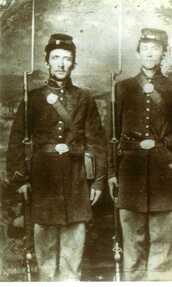
Jerry, as Jeremiah was often called, was married to Amanda Kindle after he returned from the War. As was stated in his obituary they were parents to nine children. It is said that he never recovered his health after the War and that much of the work was left for the slight compassionate lady who was his wife. He was often criticized by others who judged their relationship from the outside. Although his enlistment papers stated he was 18, Jeremiah had just turned seventeen when he and his friend Charles Windmiller followed the idealistic call to war. Charles was always by his side as he was in the picture of both the boys in their Union uniforms. They joined the 49th Missouri Infantry in Mexico, Missouri on the 15th day of December in 1864. Family lore tells that Charley practically carried Jeremiah home from the War, due to his physical debility. Jeremiah spent May and June of 1865 hospitalized with typhoid in Saint Mary’s Hospital, Montgomery, Alabama. In a letter written during his hospitalization revealing of his emotions, he states he is lonesome and reprimands his family for not writing him as he recovers.
​
As part of the 49th Missouri, Jeremiah would be part of the patrol of the Northern Missouri Railroad in the early days of his enlistment. In February of 1865, he was sent with his regiment to New Orleans and then to Mobile, Alabama, to fortify the defenses of Mobile Bay. The regiment was part of the capture of Fort Blakely on April 9. Jeremiah and Charles were part of company H who were mustered out on December 20, 1865, in Opelika, Alabama. ​
0 Comments

​​James Redman Wisner

11/13/2022

0 Comments

 
Picture
James Redman Wisner, the son of Moses Carpenter Wisner and Elizabeth Ann Bunce, was born in Wayne County, New York, September 29, 1826. He married Siphronia Wilkinson, daughter of Aaron Wilkinson and Polly Wilkes, September 27, 1849, in Wayne County.

J.R., as he was often called, volunteered for service early in the war but was sent home, being deemed too old. He was finally accepted for duty on August 25, 1864, at Auburn, New York. He was a month shy of his 38th birthday when he enlisted and served as a private in the New York 15th Engineers, Company C. He was stationed at Petersburg for the majority of remainder of the war. The New York 15th was also at Appomattox Court House April 9, 1865 for the surrender of Confederate Robert E. Lee and his army to the Union, and the expedition to reinforce General Sherman, April 23-29.

J.R. mustered out of the service on June 13, 1865, at Fort Berry, Virginia. His service record says he was 5 foot 7 inches tall with grey eyes, brown hair, and a light complexion. He received a pension of $9 a month for an injury to his knee that he sustained in a fall at Petersburg.

J.R. and Siphronia had three children: Augusta, my great grandmother (born August 24, 1850), James Carpenter (born January 7th, 1858), and Erissa (born August 9, 1864), who was only a few weeks old when J.R. went off to war.

In early 1867 the family moved from New York to LaSalle County, Illinois where Augusta met my great grandfather, Allen Griffith. They wed on April 9, 1868, at the home of her parents in Ottawa, Illinois. Allen and August had seven children. Augusta died April 17, 1896, from a fall from a runaway buggy while coming home from Easter church services in Ransom, Illinois. The fall left her paralyzed. She passed away two days later on April 17, 1896 at the Griffith farm in Ransom.

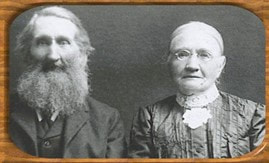
In February 1880, J.R. and Siphronia, along with their son James, daughter Erissa, and son-in-law Thomas Varah, moved to Hastings, Adams County, Nebraska where they bought farmland and lived out the rest of their days surrounded by a large family. Many descendants still live in the Hastings area. Siphronia died May 1, 1917 and J.R. died February 8, 1918. They are buried in Greenwood Cemetery in Doniphan, Nebraska. They were married 68 years and five months...a long and happy life together.

0 Comments

Thomas C. Jackson

11/13/2022

0 Comments

 
Picture
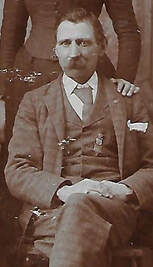
My Ancestor is my Great Great Grand Father Thomas Jackson, who was my Grandmother's father.  Interestingly, he was not the Patriot I used to become a member of Daughters of Union Veterans of the Civil War.  It wasn't until late in 2020, after doing research on my Grandmother's family, I discovered he had also served.  I have a photo of him, his wife, and two daughters – one of the daughters is my Great Grandmother Margaret.  Upon examining an enlargement of the photo, I saw that he is wearing his Grand Army of the Republic medal. Thomas Jackson served in the 78th Infantry Regiment of Ohio in Company I which was organized on October 24, 1861. He mustered in on December 20, 1861, and served until he mustered out in January 12, 1865, in Beaufort, North Carolina. The 78th of Ohio fought in Tennessee, the Siege of Vicksburg, Mississippi, Louisiana, Alabama, Kenesaw Mountain and the siege of Atlanta, Georgia, and their last battle was in North Carolina.  The original members were mustered out by reason of expiration of the term of service on January 12, 1865.  
--Donetta Bantle  ​

0 Comments

Corporal John Henty Barton

11/13/2022

0 Comments

 
John Henry Barton is my third great grandfather on my mother’s side of the family tree. Born in New York state in 1834, he grew up on his family’s farm in the town of Liberty. John Henry married Henrietta Brown on July 27, 1859, and a year later they welcomed their first child, a son whom they named Arthur. Remaining close to the rest of the Barton family, John Henry continued to work on the farm in Liberty. The young Bartons welcomed their first daughter, Clara, on the day after Christmas in 1862; she is my great-great grandmother.

I don’t know what John Henry thought about the war raging mostly to the south of his home. Newspapers would have reported the advances of General Lee and the leadership changes on the Union side. Enlistment numbers continued to fall short, however, prompting Senator Henry Wilson of Massachusetts to introduce the first Conscription Act, which Congress passed in March of 1863. For reasons that remain unknown to me, it was not until December of 1863, several months after the Gettysburg Campaign, that John Henry mustered in as a Private in the United States Army. Some records indicate that he was drafted while others clearly say, “enlisted.” To my knowledge, no photograph has survived of him, but his papers indicate that he stood 5 feet and 6 inches tall, had light hair and blue eyes.

On December 29, 1863, Private John Henry Barton became a part of the 54th NY Infantry Regiment, Company I. The regiment had fought bravely at Gettysburg before being attached to the Department of the South and sent to South Carolina.
By the time Private Barton joined the 54th NY, the soldiers had already been “building fortifications, patrolling, and recon-noitering” on the islands around Charleston. He was promoted to the rank of Corporal in January of 1865, though the reason for such a large promotion has not yet been discovered. Three months later the 54th NY marched into the heavily bombed and evacuated city of Charleston.

Detachments of the 54th NY served at Freedmen’s Bureau sites throughout South Carolina for the next year. While on such a mission near Aiken, SC, Corporal John Henry Barton received a wound to his left leg. Pension papers filed many years later revealed that there was no surgeon present when he was originally wounded, and the healing was so incomplete that it compromised his ability to work when he returned home.

Although the war ended in the spring of 1865, Corporal Barton was one of many soldiers who remained on active duty until April of 1866. The 1870 Census records show that he and Henrietta were still living in Liberty and had a new child, a daughter named Ida. Five years later the family had grown to include another girl, Harriet, and a boy they named Edgar. The 1880 Federal Census indicates that the family had moved to Landis Township, NJ, sometime after 1878, because a son, Jay, had been born in NY and was only a year old at the taking of the census.

On November 23, 1885, John Henry Barton died of Bright’s Disease, a kidney ailment. In 1889 his widow, Henrietta received a pension to help raise their minor children. Henrietta lived until 1922. An article about the 54th NY, written in 1902, reported an active Veteran’s group meeting in NYC. I think it is worth noting that the author made mention of the men striving “to imbue their own children and the rising generation with the patriotic enthusiasm that impelled” them “to offer their all to the cause…” Whether additional facts ever reveal more information about my veteran ancestor, I trust that he knows of my membership in the Daughters of Union Veterans of the Civil War and the honor that I pay to him. ​
0 Comments

George Washington Hoffmaster

11/13/2022

0 Comments

 
​George Washington Hoffmaster was born in 1837 in Reading, Pennsylvania, to Richard and Mary Hoffmaster. He married Anna Roeder, an immigrant from Germany in 1858. We think he served with the Union Pennsylvania Volunteers, 122nd Regiment, Pennsylvania Infantry, Company A. He was a professional Brick Mason, part of the firm G. W. Hoffmaster & Son brickwork and furnace contractors. He had two younger brothers that served the Union during the Civil War. Corporal John Richard Hoffmaster was born in Reading, Pennsylvania, in 1839. He served with the Union Pennsylvania Volunteers, 50th Regiment, Pennsylvania Infantry, Company B. He was wounded, shot through the left breast, the bullet passing through his left rib. He was confined to a hospital for six months, after which he was honorably discharged. He never married and was a professional brick mason. Private William Benton Hoffmaster was born in Reading, Pennsylvania, in 1841. He served with the Union Pennsylvania Volunteers, 46th Regiment, Pennsylvania Infantry, Company E. He was missing at Winchester, 25 May 1862, captured at Front Royal, Virginia. He was a sick and debilitated prisoner. After he was paroled, he was sent to Annapolis, Maryland. He eventually made it home to Reading, Pennsylvania and died on 17 Nov 1862. He never married and was a professional brick mason.
0 Comments

Captain’s Cook Philip Beslow

11/13/2022

0 Comments

 
Philip Beslow, ancestor of Norma Fields, was born in Beaufort, S.C. circa 1820. He was the son of his master, Philip John Besselieu, (alternative spelling), and Philip John’s Slave, Charlotte. The Besselieu’s were a prominent family in Charleston. They came to South Carolina from St. Thomas in the Danish West Indies. Born in 1788 in Charleston, Philip John was the youngest son of Philip Anthony Besselieu, headmaster of the Charleston Orphan House, the nation’s first municipal orphanage founded in 1790. President George Washington laid the cornerstone in 1791. The elder Besselieu owned at least 45 Slaves. Five of his grandsons fought for the confederacy in the Civil War.

An online memorial to Philip Anthony states, “… his son Philip John became well known in Cooswathcie and lived among the native Americans.” Census data does not support this statement. U.S. census from 1820 to 1840 show Philip as the only white person living with adult slave women and slave children. The 1860 census lists Philip Beslow, born in the great state of South Carolina, as head of a household in New Bedford, Massachusetts, in which he was the only white person. Included in the household were a Black woman named Charlotte, 3 mulatto adults and 3 mulatto children. Philip John was very well known in Cooswatchie, He served as Postmaster for almost eight years. My 3rd generation great grandfather is not listed in the New Bedford Census. He was living in Brooklyn, New York at the time. He left Beaufort much earlier, circa 1835.

Slavery was extremely severe and often brutal in South Carolina. The large slave population in the low country was a grave concern for the master class. They were always on guard against Slave insurrection. The legislature instituted Slave Codes designed to halt the increase in the free Black population. Free Blacks were forbidden to enter the state. Free Black sailors were to be jailed at their Captain’s expense while their ships were docked at Charleston. The state placed a ban on manumissions in 1820. Slaves could only be freed in SC by escaping. Philip must have been gifted with a spirit of adventure and an unquenchable thirst for freedom. He left Beaufort between the ages of 12 and 15. He could not read or write and according to the laws of SC he was a fugitive slave, subject to the very real dangers of being kidnapped, stolen, and returned to a Slavery far more evil and vile than the one he left behind.

I believe Philip left Beaufort with help from his father, who may have had some connection with the Underground Railroad. It is likely Philip left Beaufort stowed away aboard a merchant ship bound for Portsmouth, Virginia. Black mariners often hid Slaves aboard their vessels helping them escape to freedom. Portsmouth was a station on the Underground Railroad. He must have received help and support in Portsmouth because he remained in Norfolk, working as a mariner on merchant ships. Black seamen were assigned to menial duties aboard the ships. They were cabin boys, stewards, firemen, janitors, painters, and Captain's Cooks and they were subject to vicious racism. They were always in danger of being kidnapped and sold back into slavery. Despite the drawbacks, sailing was a profession black men saw as an occupation of opportunity. Sailors were popular in their community. They were men who brought stories of mobility back to a stagnant community. The Black community was proud of them.

In 1855, Philip enlisted in the United States Navy. His recruitment papers describe him as a mulatto, 5 feet, 5 inches tall, with black hair and eyes. It was a phenomenal opportunity for a black man to be a member of the United States Navy. Unlike the Army, the Navy has always been integrated. Since its creation in 1798, by Act of Congress the Navy has never barred Black men from serving; they needed the manpower as people were not standing in line to join what was considered a dangerous occupation and they were not concerned black men at sea posed as great a threat as armed black men in the Army. From the 1840s until the Civil War the number of black sailors was limited to 5% of naval population. Slightly over 118,000 sailors served in the war, almost 18,000 were black, 11 were women. Black sailors were assigned to menial duties aboard naval ships, but in times of general quarters, all hands on deck, blacks served on the gun crews, small arms crews, swords pistols and rifles to repel boarders. Eight black sailors were awarded Medals of Honor for acts of bravery during the Civil War.

The first ship Philip served on before the war, was the USS Pennsylvania, a Receiving Ship out of Norfolk, Virginia. He was rated a Captain’s cook. Rank varied from enlistment to enlistment for black sailors, depending on the temperament of the Captain. The second ship he served on was the Revenue Cutter, Harriet Lane. In Feb 1861, Philip re-enlisted in the Union Navy and would serve for the duration of the Civil War. Philip served on four ships during the war, again on The Harriet Lane, The Oswasco, The O.H. Lee, and The New Hampshire. He saw plenty of action onboard ship. His engagements included Fort Sumter, Pigs Point, Hatteras Inlet, Galveston, Vicksburg, Fort Jackson, New Orleans. While onboard the O.H. Lee, Philp received an injury to his eyes from an exploding shell. The injury would eventually make him partially blind. At the end of the war Philip reenlisted aboard the New Hampshire. He was discharged from the Navy in 1871.

Over 30 years of life at sea took a terribly high toll on Philip’s Health. He suffered from rheumatism, paralysis on one side, partial blindness and other ailments. The pension Act of 1890 awarded Invalid Pensions to Civil War veterans who could prove their injury or illness was in the line of duty. Philip began his quest for a pension in 1890, a time, Historian Rayford Logan called the nadir of race relations in America. Reconstruction ended in 1877 and the KKK was on the rise, as was segregation. His statement appeared proven correct when a claims agent, Charles Brown, whom Philip gave his discharge papers to, either lost or destroyed them. For Philip to qualify for a pension he had to contact doctors and shipmates who could validate his claims. With the help of staff at the Old Soldiers Home, he was able to hire a lawyer to help him make his claim. The lawyer sent requests for affidavits throughout the country. The response he received was most heartening. White people came to his aid. Members of the Norfolk clergy and community, ship mates, two surgeons from Massachusetts went back through 30 years of paperwork to find entries of treating Philip. A racist and infelicitous claims agent may have lost or destroyed his discharge papers, but good people over came even during the nadir of race relations in this country.

Philip was awarded an $8.00 monthly pension in 1893. The equivalent of $208.00 today. It was lower than most pension awards. In 1896 he applied for an increase. His pension was increased to $12.00 a month, the equivalent 0f $312.48 today. Only 5% of Black veterans received pensions.

Philip married Sarah Fraction, a free black woman from Norfolk circa 1855. They moved to Brooklyn, New York. They had five children, Charles, Lewis, Emma, Charlotte, and Lillian. Lewis, born in Brooklyn in 1861, was my great, great grandfather.
Philip died in 1898. He is buried in West Point Cemetery in Norfolk, Virginia. A cemetery established after the War for Black Civil War veterans.

I am proud of him and I know Philip is proud of his 4th generation grandson, who, because of the great men and women of the Union Army and Navy, achieved heights Philip could not possibly have imagined, retired Army Major Anthony Fields, a 1999 graduate of the United States Military Academy. I get emotional when I think about my ancestor fighting in the Civil War. African Americans see the war as a war for freedom. I’m sure that’s how he saw it. He fought for my freedom. When I think of the sacrifices of the men and women who fought in the Civil War, whether they fought to save the union or to free the slaves, or for both, I am overwhelmed and grateful for their sacrifice and service.
0 Comments

Adam Stewart

11/13/2022

0 Comments

 
PictureAdam Stewart and family.
Adam Stewart, ancestor of Iva L. Knapp, was born October 4, 1832, in Jackson County, Virginia. His was the son of William Stewart and Mary Parsons. William was born in Monongahela County, PA, and moved to Jackson County, VA, and then moved to Mason County in 1846 with his children. Adam married Ellen Jane Smith on March 25, 1853, in Mason Co, VA, which became WV. He was engaged in farming when he signed up to join the Thirteenth West Virginia Regiment, Company B, on August 8, 1862, in Point Pleasant, WV, and had his first muster October 8, 1862. He was wounded in action at the Battle of Kernstown (near Winchester) on July 24, 1864. He suffered a conical ball wound of his left foot. He was in the hospital at Cumberland, MD, in which the conditions in the summer were reported as unbearable. He was transferred to the hospital in Clarysville, MD, which was 1000 feet higher than Cumberland, and it provided a more hygienic situation with a purer atmosphere, seclusion to allow exercise in the open air, and abundant supply of excellent quality water. He recovered in the hospitals from July 25, 1864, until he returned to service with his unit March 6, 1865. He was mustered out on June 22, 1865. He returned to farming and had a saw mill in Mason County, WV. He was a member of the Methodist Church. His children were Almeda, Matilda, Henry T, Rachel, Sarah, Susan, James H, and my ancestor Mary Jane Stewart who married Spencer Knapp in 1873. Ellen Jane was the daughter of Isaac E Smith, a Methodist Minister, and Rachel McGuire. She was born January 7, 1833, in Mason County, WV and died on March 3, 1909. Adam Stewart died on September 8, 1902, and he and Ellen are buried at Smith Church Cemetery, in Leon Township, Mason County, WV. ​

0 Comments

Lyman Benjamin

11/13/2022

0 Comments

 
PictureLyman and Elizabeth Benjamin and their daughters, one of which is the author's Great Grandmother Adeline.
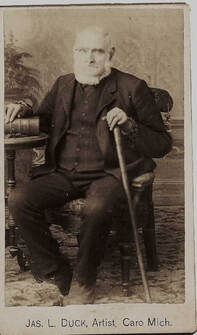
My ancestor who I used for my membership into DUVCW is Lyman Benjamin, my 3 x's Great Grandfather. I am related to him through my Grandfather Lee's mother Adeline. He was a member 14th Regiment, Michigan Infantry, Company D and held the rank of Private. He was mustered in February, 1862. His service was mainly in Tennessee, Kentucky, Mississippi, and Alabama. Due to either an injury or illness, he was Honorably Discharged in July of 1865. He returned to his home in Eagle, Michigan, where he was a cobbler. He was married to Elizabeth and had eight children. His daughter Adeline married my Great Grandfather James Bird Lee and that is my connection to Lyman.

Lyman's 2x's Great Grandfather, James Benjamin fought in the Revolutionary War and I am in the process of obtaining documents linking him to James. My search took a strange turn when I saw a head stone for someone I thought was a related to my Grandmother. Next to the headstone was a marker placed there by the Eva Gray Tent 2 in Grand Rapids, Michigan. I contacted the person listed for more information. I was contacted by Dorothea (Dottie) Piechocki from the Eva Gray Tent 2.  She has an interest in genealogy and provided me with the information about my Grandmother Lee's Grandfather Thomas Clarence Jackson. 

Thomas C. Jackson fought in the Civil War with the 78th Regiment, Ohio Infantry, Company I as a Private. He enlisted in December 20, 1861, at age 21. He fought in many famous battles and was with Sherman during the siege of Atlanta. He was mustered out on January 12, 1965. He returned to Michigan and married Isabella Montague and had 3 daughters, Mary, Margaret (my Great Grandmother), and Hannah. The very interesting thing that Dottie discovered was that in 1922, Thomas's daughter Mary married Lyman Benjamin's son James. Who would have thought that my two Civil War ancestors would be related through marriage?
--Donetta Bantle    ​

0 Comments

William Allison Fleming

11/13/2022

0 Comments

 
Picture
William Allison Fleming, 2nd Great-Grandfather of Karen S. Lyddane, a Civilian Civil War Living Historian. My family, in the 1700s, came to Bucks County, PA, and settled into Fauquier, VA. They then went to Marion, Grafton, or other border counties of Virginia that eventually formed West Virginia. While most family members were of Union alliance, I am finding that the Confederacy was strong, too. Why am I writing about this to you? Because, as a Civilian, I am constantly asked WHO I am portraying. Are you? And what, pray tell, is your answer? These words support those who represent the majority of Civilians during this War, those who convicted themselves of a certain belief, whether Union or Confederate, and who didn’t become famous. These words are for you, my dear Reader, in support of your own participation of honoring Our Time. A characteristic of America seems to be in attending only to famous figures, while we must always remember that it was the numbers of unnamed citizens, in uniform or supporting uniforms, who bore equal respect in shaping our Country. Without more delay, please read on:

The 12th West Virginia Infantry was organized August, 1862, with John B. Klunk, Colonel, Robert S. Northcott, Lieutenant-Colonel, and Francis P. Pierpont, Major. Early service was performed in West Virginia in scouting, guard duty, etc. In January, 1863, we find the Regiment at Winchester, in the Middle Department, 8th Army Corps, General Milroy’s Division. Now I skip to June 13 and 15 June, 1863, where it participated in Milory’s disastrous defense of the place, when the Regiment lost two officers and six enlisted men killed, one officer and 35 wounded. (Later, 30 June, it was at Bloody Run, in Colonel L.B. Pierces Brigade, and July 14, at Hagerstown, in Colonel A.T. McReynold’s Brigade.)

[Source: Loyal West Virginia 1861-1865, by Theodore Lang]

Recorded by the Adjutant General, Company “F” 12th Regiment, W. VA. Infantry describe my great-great-grandfather:
FLEMING, William A.; Fairmont, WV; 24; Aug 26, 1862, Wheeling, WV, June 16, 1865, Farmer, born Marion County, WV. Mustered out at Richmond, VA.

[Source: 12th West Virginia Infantry, Website, by Linda Fluharty, more at: http://www.lindapages.com/wvcw/12wvi/12thcover.htm. Contained in this article is the transcript of William Allison Fleming’s letter that he wrote to his father, John M. Fleming, while at Winchester, January 4th, 1863. (Our family has the original letter, and other artifacts that were saved from William’s service.) It is submitted with actual punctuation, spelling and spelling of the original letter.]

0 Comments

Davis Smith

11/13/2022

0 Comments

 
Picture
Davis Smith, 4th great-grandfather of Cyndi Messick, was born in 1802 in Columbia Co., New York, to John Smith IV and Abigail Burrows. John is my first DAR Revolutionary Patriot, and it took a lot of work to put all the pieces together! Davis married Mary Fox in New York and they had five children. Somewhere around 1840 he migrated with his family and his brother Levi from New York to Livingston Co., Michigan – we believe he is not shown in an 1840 census because they were traveling. The family lived in Livingston Co. until the Civil War hit.  In 1860, Davis and Mary are living with their daughter Mary Ann and her family, but by December 1861, Davis has sold all his property and enlisted for the war. I am still trying to find out what happened to Mary, because there are no records of her after the 1860 Census.  But think about it, it’s interesting to see that Davis went to war, because his father fought in the Revolutionary War!  Davis lied about his age when he registered, being too old to go. But off he went!  He was a Private with Company K, 1st Michigan Engineers & Mechanics. They marched him down to Kentucky, where he fell ill, spent time in hospital camps, and was finally sent home without seeing any action and discharged in March 1862.  Six weeks after returning to Michigan, he married a woman named Tamathy Husted Ensign, and lived in Genesee Co. About 6 weeks after Tamma died in 1872, he married Rosina Blair Harrington Brooks and moved to Tuscola Co.  The man clearly did not like being alone!  Over the years, his occupation is stated as Farmer, Mechanic, Salesman, and Minister.  He never fully recovered from his illnesses from the war, and by the time he died, he was completely invalid, according to his pension file.  He is buried in Dayton, Tuscola Co., Michigan, with his last wife Rosina.  Davis’ grave is unmarked with the exception of a GAR flag next to his wife’s stone. I was able to narrow his death to the fall of 1889 from pension payment dates, but nothing more specific. I continue to work on this, and when I find a date, I’d like to arrange a tombstone for him.
--Cyndi Messick

0 Comments
<<Previous

    Ancestor Spotlight

    Please enjoy the stories of our Patriot ancestors!

    Archives

    March 2024
    October 2023
    August 2023
    June 2023
    January 2023
    November 2022

Home
About
Join Us!
Web hyperlinks to non-DUVCW sites are not the responsibility of DUVCW, the Departments, or the individual Tents.  Copyrighted 2016 Daughters of Union Veterans of the Civil War, 1861-1865, Elizabeth Van Lew Detached Tent 1, Haymarket, Virginia. All rights reserved. ​Site created on 1 May 2016 and last updated October 2025. For questions related to this site, contact the Webmaster.