Daughters of the Union Veterans of the Civil War: Elizabeth Van Lew Tent 1 (Detached), VA
  • Home
  • About Our Tent
    • Special Events
  • Membership
  • Who is Elizabeth Van Lew?
  • Our Union Veterans
  • Ancestor Spotlight

John D. Fiske

11/7/2025

0 Comments

 
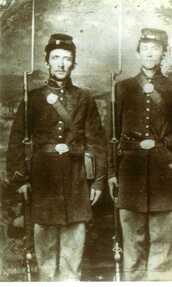
John D. Fiske, born September 28,1834, in Southbridge, Massachusetts and died 1 April 1910, in Tuckerton, New Jersey. He was a native of Massachusetts and moved to Tuckerton in 1885.  When John was 16 he shipped abroad a New Bedford whaler and spent many years at sea. He had been around the world three times and visited most every seaport of importance in the world, and when the Civil War broke out, he was in Germany but came back to the United States right away to offer service to his country at the age of 26. He enlisted 31 July 1861, in the 2nd Independent Battery, Massachusetts Light Artillery and served with honor for four years at the front. He discharged as Sergeant 11 August 1865, the same day his first wife died, leaving behind two small sons. It was said that John was quiet in manner except when pressed for travel stories of the earlier days at sea or later of the war.
 
He was stationed in: Boston, Baltimore, Virginia, New Orleans, Vicksburg, Baton Rouge and Port Hudson. He contracted malaria while stationed in Vicksburg. He applied for invalid pension at 45 years old because he was too sick to work; the government approved and he farmed and did light work. The government made his pension retroactive from date of discharge. Doctors told him to sell his farm and move to the sea shore for his health.
 
Written from the American Windjammers, The Boston Ship Nightingale, Captain John Fiske, was the pioneer Stars-and-Stipes flier on the Australian run. Twice promoted for "That reposing special trust, and confidence in the patriotism, valor, fidelity, abilities, etc."

Provided by Penny Cummiskey 
0 Comments

Sgt. Henry Heinrich Bickhardt

11/7/2025

0 Comments

 
​Henry Heinrich Bickhardt, my 3rd Great Grandfather, was born in the Lohlbach, Frankenburg area of Germany on June 1, 1827, and died on Dec. 9, 1893, in West New York, New Jersey. Sometime after 1850, Henry migrated to the United States, married Louisa Dapper in 1852, and settled in Wayne County, Pennsylvania, to start a family. Shortly before 1861, Henry moved his growing family to Hudson County, New Jersey.

As the Civil War broke out, Henry enlisted in the Union Army on July 30,1861 and was mustered into the1st New Jersey Light Artillery, Battery A (Hexamer’s Battery), on August 12, 1861, as a Private, but was shortly promoted to Corporal. Battery A, 1st New Jersey Light Artillery was organized at Hoboken, New Jersey, under the command of Captain William (Wilhelm) Hexamer. Many of its members were of German descent. The Battery left New Jersey for duty in the Defenses of Washington, D.C., on August 20,1861. It participated in the Peninsula Campaign of 1862 (April-July 1862), 2nd Bull Run Campaign (August-September 1862), the Maryland Campaign (September 1862), and the Battle of Antietam (Sept. 17, 1862). On Nov. 8, 1862, Henry Bickhardt was promoted to Sergeant. The Battery then moved on to Virginia and participated in the Battle of Fredericksburg (December 12-15th, 1862), and the disastrous Mud March (January 20-24th, 1863). The Battery continued with the Chancellorsville Campaign (April 27-May 6,1863), the Gettysburg Campaign (June 11-July 24, 1863), Bristoe Campaign (October 9-22, 1863), and the Mine Run Campaign (November 26-December 2, 1863). On January 29, 1864, Henry Bickhardt was transferred from Battery A to 1st New Jersey Light Artillery, Battery C. Bickhardt was promoted to Sergeant on Sept. 1, 1864. Battery C participated in the Siege of Petersburg (June 1864 - April 1865) and the Appomattox Campaign (March 25-April 9, 1865). After the fall of Petersburg and Richmond, Battery C initially pursued after Lee’s retreating Confederate army but stopped at Ford’s Station on April 7, 1865. It was not present at Appomattox Court House for the Confederate surrender. The Battery then moved to Washington D.C. and participated in the Grand Review on May 23, 1865.
​
On June 19, 1865, Battery C and Henry Bickhardt were mustered out of service at Trenton, New Jersey. After Henry returned from the War, he settled with his family in the town of West New York, New Jersey and helped start the first all-volunteer fire department for the town. He began to invest in land in West New York and bought several properties on Polk and Madison Streets. And this is where the story begins to cross my own past. I spent the first seven years of my life in West New York, New Jersey (born in Jersey City). I was raised on Madison Street and my parents, two brothers, and I lived next to our family homestead. Only after doing extensive Ancestry research on the Haller/Bickhardt side of my maternal grandmother, did I find Henry. Growing up, my relatives never mentioned Henry and his family, or his service in the Union Army. I’m sure they didn’t even know he existed. Using information from the Hudson County Genealogical Society in New Jersey, I was able to obtain land deeds and surveyor maps of West New York. After carefully inspecting the land deeds, I realized my Madison Street family homestead land, next door to my parent’s house, was owned by Henry and eventually sold to a family member. Henry also owned property across the street from my parent’s house. In the late 1870’s Henry’s brother, Conrad, built the first public school in West New York on Madison Street. Years later it burned to the ground and was rebuilt with brick. My two brothers, myself, and most of my family members went to that new school down the block during our own elementary years. Lastly, I want to mention that I now live in Powhatan, Virgina, on 20 acres of land. Down the road, approximately three miles from my house, Lee made his last camp with his Army, right after fleeing from Richmond. There is a good chance Henry, and the men of Battery C walked on my property as they pursued Lee and his Army. 

Provided by Jill Cucaz
0 Comments

John Jackson Strohl

3/6/2024

0 Comments

 
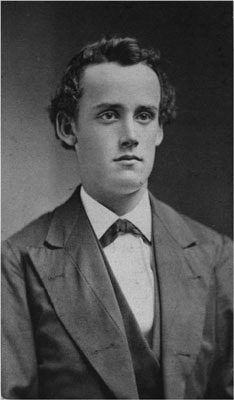
John Jackson Strohl was born on 23 Aug 1841 in Laurel Township, Hocking Co., Ohio. He was the son of John William Adam Strohl and Elizabeth Rittigers. His family was farmers and he also was farming in Laurel Township when he enlisted in  Company H, 58th Ohio Regiment of the Ohio Infantry on October 2, 1861 at Millville, Ohio. He was 20 years old when he enlisted.
 
In January of 1863 he was detached from Company H, 58th Ohio Regiment of Infantry to Landgraeber’s Battery, 1 Mo. Horse Artillery where he became an ambulance driver. He was a part of the Siege of Vicksburg (May 18-July 4, 1863). Some historians believe the Siege of Vicksburg was the final major military action in the Vicksburg Campaign of the American Civil War. In a series of maneuvers, Union General Maj. Gen. Ulysses S. Grant and his Army of the Tennessee crossed the Mississippi river and drove the confederate army of Vicksburg led by Lt. Gen. John C. Pemberton into the defensive lines surrounding the fortress city of Vicksburg, Mississippi.
 
When two major assaults (May 19 and 22, 1863) against Confederate fortification were repulsed with heavy causalities, Grant decided to besiege the city beginning on May 25. With no reinforcement, supplies nearly gone, and after holding out for more than 40 days, the garrison finally surrendered on July 4. This action (combined with the surrender of Port Hudson to Maj. Gen. Nathaniel P. Bank on July 9) yielded command of the Mississippi River to the Union Forces, who would hold it for the rest of the conflict.
 
The Confederate surrender following the Siege at Vicksburg is sometimes considered, when combined with Gen. Robert E. Lee’s defeat at Gettysburg by Maj. Gen. George G. Meade the previous day, the turning point of the war. It cut off the states of Arkansas, Louisiana, and Texas from the rest of the Confederacy, as well as communication with Confederate forces in the Trans-Mississippi Department for the remainder of the war.
 
Then John Strohl returned to the 58th Ohio Regiment. There he was a teamster and supply driver. He was injured lifting a heavy load and was not able to recover sufficiently to continue service.
 
He was mustered out at Camp Chase, Ohio on January 14, 1865 according to muster roll records but U.S. Civil War Soldier Records and Profiles, 1861-1865 indicate that he was mustered out at Vicksburg, Mississippi. He came to Colfax Township in Champaign County, Illinois, where he had family. He married Sarah Gordon 21 March 1867 at Centerville, Piatt Co., Illinois. John and Sarah had 14 children. John was a farmer and he and Sarah purchased land in Piatt and Champaign Co.
 
John developed tuberculosis so he moved most of his family to Acampo County, California where the weather was better for his health. He died at Woodbridge, Acampo County, California, on 21 March 1901. His body was brought back to Monticello, Piatt Co., IL by train where he is buried. Sarah Strohl was able to receive a pension from the government  because of John’s civil war service. Sarah died in 1928 and is buried beside her husband in the Monticello Cemetery.
 
Family lore says when John Strohl came home after being mustered out, he walked from the train station in Champaign to Monticello where his family was, despite being injured. A family member, Dayton Strohl, had John’s musket from the civil war. When Dayton’s only son, Floyd Strohl's, plane disappeared on a flight over the Himalayan Mountains in WW II he was so upset about war that he took the musket to the University of Illinois in Champaign where Floyd was a engineering student when he enlisted. He donated the musket to the University although no record of the gun being donated has been found so the whereabouts of the musket remain unknown.
0 Comments

Feddeman Frisby Rolle

10/21/2023

0 Comments

 
Feddeman Frisby Rolle (1828–1901) was born in Fleming, KY, where his parents, Thomas and Elizabeth Rolle lived, because Elizabeth’s father, DAR Patriot Robert Rolle, moved westward. Marrying his cousin, Thomas was the son of DAR Patriot, John Rolle. Upon Elizabeth’s death, Thomas brought his children back to Talbott County, MD, the home of the Rolle family since Dr. Francis Rolle arrived in 1707. Feddeman’s grandfather, who built the home on Rolle’s Range still occupied today, served in the colonial militia as a member of the Talbot County MD Troop of Horse in 1748. Military service was a Rolle family tradition that continued though the Revolution, the Civil War and with Feddeman’s son, Thomas, serving in the Indian wars as a Corporal in Company I, 3rd US Cavalry.

Feddeman and Anna Eliza Webb were married on 20 February 1851, and the 1860 census names him as a farmer and head of household.  He served in the Civil War, enlisting as a Private on 18 September 1861 in Co. H, 1st Eastern Shore Home Guard.  He was honorably mustered out on 23 December 1864.  This unit volunteered, thinking they would stay in the area. Instead, they served as part of the 1st Eastern Shore Maryland Infantry in the Battle of Gettysburg July 2-3 and in the pursuit of Lee July 5-24.
​
Feddeman and Anna Eliza Rolle had six children. He worked as a blacksmith, and he owned a farm near the town of Trappe, a stop on the steamship lines. It was in 1898 that the Bureau of Pensions was set up and provided pensions for the men serving in the war. He only received it for a few years, $12 a month, but his wife continued to benefit from this income.  Feddeman died 10 Nov 1901 and is buried at Spring Hill Cemetery, Easton, MD.
 
Ancestor of Ann Kay Kirsch Gilbert
Lineal Descendant of her 2nd Great Grandfather
Private Feddeman F. Rolle
Co. H, 1st ES Maryland Infantry
Daughters of Union Veterans of the Civil War
0 Comments

Jacob Lipscomb

8/19/2023

0 Comments

 
My 3rd Great Grandfather Jacob Lipscomb was born on October 6, 1832, in Preston County, Virginia (now West Virginia). His father, James, was 39 and his mother, Ann, was 29. He married Sarah Frances Judy of Randolph County, Virginia on November 4, 1855 and they went on to have four children together. Jacob Lipscomb was a farmer aside from wartime.
 
During the Civil War, Jacob was 30 years old when he enlisted September 13, 1864, in the West Virginia 6th Volunteer Infantry Regiment in Company N, as a Private for the term of 1 year. The Regiment was organized for railroad guard duty and served on the line of the Baltimore & Ohio Railroad by detachments, at various points west of Sleepy Hollow, Virginia. Jacob enlisted in Grafton, Taylor County, West Virginia. According to records from the time, he was 5’11" and had fair complexion, blue eyes, and dark hair. He mustered out June 10, 1865, in Wheeling, West Virginia, after the war had ended in April/May.
 
Jacob Lipscomb died on September 15, 1914, in St. George, Tucker County, West Virginia, having lived a long life of 81 years. He is buried in Tucker County, West Virginia along with generations of my family.

Provided by Rachel Dowling
0 Comments

Jacob C. Hofmeister

6/7/2023

0 Comments

 
Picture
Submitted by Taylor Nichols

Jacob C. Hofmeister was born on September 13th,1843 in Columbiana County, Ohio. He was the fourth child of immigrant father Johannes Hofmeister who came to the United States from the Kingdom of Württemberg, Germany in 1832.  By 1838 when Johannes married Elizabeth Kohl, Johannes was living in Columbiana County, Ohio and was a farmer.

On September 21st, 1864 Jacob enlisted in Company F of the Ohio 177th Infantry Regiment for a one-year term. The Regiment proceeded to Nashville, Tennessee via Indianapolis and Louisville then to Tullahoma, Tennessee, and garrison duty there under General Milroy until November 30. Ordered to Murfreesboro, Tennessee, November 30, arriving there December 2. 

On December 7, Milroy's command charged the works and drove the Confederates back, capturing 2 pieces of artillery and over 200 prisoners.  A few days after this, while on a foraging expedition, the regiment had an engagement with the enemy, in which it lost several wounded.  After the surrender of Gen. Johnston, the regiment was sent to Greensboro, N.C. where it was mustered out onJune 24th, 1865, in accordance with orders from the War Department.  Source:  The Union Army, vol. 2.

After the war, Jacob married Margaret Almira Crum on October 21st, 1869 in neighboring Lawrence County, Pennsylvania.  They lived in East Palestine, Columbiana County, Ohio until their deaths and had six children. Jacob was a carpenter, and he built many homes in East Palestine, many of which are still standing. Jacob died on August 2nd, 1910 at the age of 67 in a hospital in Pittsburgh, Pennsylvania, after surgery.

0 Comments

Joel Nelson McClure

1/29/2023

0 Comments

 
Joel Nelson McClure was born on 23 March 1839, in Annapolis, Penn Township, Parke, Indiana, his father, Mordecai McClure, was 44 and his mother, Mary Ann Vickers, was 34. He married Almyra Vinetta Mason on 28 March 1878, in Paris, Edgar, Illinois. They were the parents of at least two sons and one daughter. He lived in Edgar, Illinois, in 1850 and  Vermilion, Illinois, in 1880. He died on 11 December 1907, in Dana, Vermillion, Indiana, at the age of 68, and was buried in Friends Chapel Cemetery,  Edgar, Illinois. He was a Sargent in the 5th Missouri State Calvary Militia. He was my Great great grandfather on my grandmother's paternal side. When my grandmother was 3 years old, her mother passed away and her father (Joel's son) left the 5 kids in the care of their maternal grandmother. My grandmother had little contact with her paternal side from then on. Because of that, I grew up with little knowledge or information from my grandmother about that side of the family. I have great pride in my ancestor serving his country in the Civil War and extremely grateful he returned home safely. --Luanne Kane
0 Comments

Jeremiah Guthrie

11/13/2022

0 Comments

 
Picture
On a spring day in 1920 Jeremiah Guthrie, “sat shaving his chewing tobacco and laying the small pieces on the hot stove to warm awhile before he put them in his pipe to smoke it.” In this account written by his granddaughters, Linda and Rainy Guthrie, they described that, “as he performed this little ritual, his legs stiffened and he slid to the floor and he was gone.”

His obituary was written by one of his sons, my great grandfather, William Albert Guthrie. Jeremiah Guthrie was born December 11, 1847, near Martinsburg, Pike County, IL of parents who in an early day migrated from Kentucky; died suddenly April 23, 1920. In the early winter of 1864 he, in company with another boy Chas. Windmiler, enlisted in the 49th Inf. of Missouri Volunteers at Mexico, Mo. for one year. A few years later at a meeting held by John Homer and Fred Priestly he professed religion and joined the Baptist Church at Pleasant Hill. He was united in marriage to Amanda Kindle Sept. 28, 1869, at Pleasant Hill. She proceeded him to the Great Beyond May 19, 1914. To them were born: William Albert, Oscar, Robert, Clifford, Elza, Henry, Mrs. Walter Grimes, Mrs. Ora Kinkade and Mrs. John Pruett all of whom are married and living within one-half hour’s travel. He also leaves to keenly feel his loss, forty-eight grandchildren, seven great- grandchildren, and two sisters.

Jerry, as Jeremiah was often called, was married to Amanda Kindle after he returned from the War. As was stated in his obituary they were parents to nine children. It is said that he never recovered his health after the War and that much of the work was left for the slight compassionate lady who was his wife. He was often criticized by others who judged their relationship from the outside. Although his enlistment papers stated he was 18, Jeremiah had just turned seventeen when he and his friend Charles Windmiller followed the idealistic call to war. Charles was always by his side as he was in the picture of both the boys in their Union uniforms. They joined the 49th Missouri Infantry in Mexico, Missouri on the 15th day of December in 1864. Family lore tells that Charley practically carried Jeremiah home from the War, due to his physical debility. Jeremiah spent May and June of 1865 hospitalized with typhoid in Saint Mary’s Hospital, Montgomery, Alabama. In a letter written during his hospitalization revealing of his emotions, he states he is lonesome and reprimands his family for not writing him as he recovers.
​
As part of the 49th Missouri, Jeremiah would be part of the patrol of the Northern Missouri Railroad in the early days of his enlistment. In February of 1865, he was sent with his regiment to New Orleans and then to Mobile, Alabama, to fortify the defenses of Mobile Bay. The regiment was part of the capture of Fort Blakely on April 9. Jeremiah and Charles were part of company H who were mustered out on December 20, 1865, in Opelika, Alabama. ​

0 Comments

​​James Redman Wisner

11/13/2022

0 Comments

 
Picture
James Redman Wisner, the son of Moses Carpenter Wisner and Elizabeth Ann Bunce, was born in Wayne County, New York, September 29, 1826. He married Siphronia Wilkinson, daughter of Aaron Wilkinson and Polly Wilkes, September 27, 1849, in Wayne County.

J.R., as he was often called, volunteered for service early in the war but was sent home, being deemed too old. He was finally accepted for duty on August 25, 1864, at Auburn, New York. He was a month shy of his 38th birthday when he enlisted and served as a private in the New York 15th Engineers, Company C. He was stationed at Petersburg for the majority of remainder of the war. The New York 15th was also at Appomattox Court House April 9, 1865 for the surrender of Confederate Robert E. Lee and his army to the Union, and the expedition to reinforce General Sherman, April 23-29.

J.R. mustered out of the service on June 13, 1865, at Fort Berry, Virginia. His service record says he was 5 foot 7 inches tall with grey eyes, brown hair, and a light complexion. He received a pension of $9 a month for an injury to his knee that he sustained in a fall at Petersburg.

J.R. and Siphronia had three children: Augusta, my great grandmother (born August 24, 1850), James Carpenter (born January 7th, 1858), and Erissa (born August 9, 1864), who was only a few weeks old when J.R. went off to war.

In early 1867 the family moved from New York to LaSalle County, Illinois where Augusta met my great grandfather, Allen Griffith. They wed on April 9, 1868, at the home of her parents in Ottawa, Illinois. Allen and August had seven children. Augusta died April 17, 1896, from a fall from a runaway buggy while coming home from Easter church services in Ransom, Illinois. The fall left her paralyzed. She passed away two days later on April 17, 1896 at the Griffith farm in Ransom.

In February 1880, J.R. and Siphronia, along with their son James, daughter Erissa, and son-in-law Thomas Varah, moved to Hastings, Adams County, Nebraska where they bought farmland and lived out the rest of their days surrounded by a large family. Many descendants still live in the Hastings area. Siphronia died May 1, 1917 and J.R. died February 8, 1918. They are buried in Greenwood Cemetery in Doniphan, Nebraska. They were married 68 years and five months...a long and happy life together.

0 Comments

Thomas C. Jackson

11/13/2022

0 Comments

 
Picture
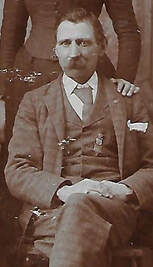
My Ancestor is my Great Great Grand Father Thomas Jackson, who was my Grandmother's father.  Interestingly, he was not the Patriot I used to become a member of Daughters of Union Veterans of the Civil War.  It wasn't until late in 2020, after doing research on my Grandmother's family, I discovered he had also served.  I have a photo of him, his wife, and two daughters – one of the daughters is my Great Grandmother Margaret.  Upon examining an enlargement of the photo, I saw that he is wearing his Grand Army of the Republic medal. Thomas Jackson served in the 78th Infantry Regiment of Ohio in Company I which was organized on October 24, 1861. He mustered in on December 20, 1861, and served until he mustered out in January 12, 1865, in Beaufort, North Carolina. The 78th of Ohio fought in Tennessee, the Siege of Vicksburg, Mississippi, Louisiana, Alabama, Kenesaw Mountain and the siege of Atlanta, Georgia, and their last battle was in North Carolina.  The original members were mustered out by reason of expiration of the term of service on January 12, 1865.  
--Donetta Bantle  ​

0 Comments
<<Previous

    Ancestor Spotlight

    Please enjoy the stories of our Patriot ancestors!

    Archives

    March 2024
    October 2023
    August 2023
    June 2023
    January 2023
    November 2022

Home
About
Join Us!
Web hyperlinks to non-DUVCW sites are not the responsibility of DUVCW, the Departments, or the individual Tents.  Copyrighted 2016 Daughters of Union Veterans of the Civil War, 1861-1865, Elizabeth Van Lew Detached Tent 1, Haymarket, Virginia. All rights reserved. ​Site created on 1 May 2016 and last updated October 2025. For questions related to this site, contact the Webmaster.